
Do You Need AI SEO? What Google Actually Says
Find out whether AI search is sending you anything, before you pay anyone to optimise for it. AI SEO is established search engine optimisation applied to search experiences that generate answers instead of returning only a list of links. Google’s own position, published in June 2026, is that good SEO is good GEO. Answer Engine Optimization, Generative Engine Optimization and AI SEO are not separate ranking systems. This article sets out what Google states, which sales claims Google rejects, and what Dr IT SEO Services handles for a local business.

Get a Free, No-Obligation SEO Audit
Vlad reviews your website, Google Business Profile and current search presence, then tells you where the problem actually starts.
Mon-Fri 09:30-17:30 · Birmingham & West Midlands
Do You Need AI SEO?
Most businesses do not need a separate set of AI search tactics. In June 2026 Google published its position under the heading “Good SEO is good GEO”. Google states that its generative AI features are rooted in the same core ranking and quality systems as traditional Search, and that because these AI experiences retrieve up-to-date content from the existing search index, the best formula for success remains foundational SEO.
What a business needs is a technically accessible website, accurate company information, useful content that only it can write, independent evidence, and a way to measure whether visibility produces enquiries. That list has not changed because of AI.
The concern behind the question is still legitimate. Customers now receive recommendations, comparisons and explanations before they visit any website. Google AI Overviews, Google AI Mode, ChatGPT, Gemini and Perplexity can decide which companies enter a shortlist. The work that earns a place in that shortlist is the work described on this page, and it has an older name.

What Is AI SEO?
AI SEO is the work associated with a business’s visibility inside AI-generated search experiences. It covers the same website, content and authority signals used in SEO, with additional attention to generated answers, source citations, brand mentions and AI-assisted customer journeys.
Answer Engine Optimization is an industry label for work intended to make information suitable for answer-led interfaces. An answer engine responds to a question with a written explanation or recommendation rather than requiring the user to inspect a list of results.
Generative Engine Optimization is another industry label, for work intended to improve representation inside generated answers. It usually refers to whether an AI system retrieves a source, interprets its information correctly, and includes that information in a response.
AI visibility is the observable outcome rather than the name of a ranking system. A business has AI visibility when a generated response names the company, cites its website, describes its services, or uses its information to support an answer.
SEO remains the wider discipline connecting all of these. Search engines still discover websites, process pages, evaluate relevance and decide which sources deserve visibility. Google’s June 2026 article addresses the naming directly: “Don’t worry about all the new names. Good GEO, AEO, LLM SEO is good SEO.”

What Google Actually Says About AI SEO
Google set out its position in an article by Brendon Kraham published in June 2026 on Think with Google, titled “Create & capture demand in the AI Search era”. Three statements in it settle most of the argument.
“Our new generative AI features are rooted in the same core ranking and quality systems as traditional Search. And, because these AI experiences retrieve up-to-date content from the existing search index, the best formula for success remains foundational SEO.”
Brendon Kraham, Google, June 2026
That single sentence removes the premise behind most AI SEO packages. AI Overviews and AI Mode are not a separate index with separate rules. They read the same index, ranked by the same systems.
“Don’t optimize for bots. Optimize for people… There’s no need to write awkward, keyword-stuffed copy or chunk your content into tiny, artificial snippets. Our systems understand language just like a human.”
Brendon Kraham, Google, June 2026
Content chunking, prompt-matched page variants and keyword-dense rewriting are named here as wasted effort rather than as requirements.
“You can also stop worrying about new technical formats or special AI text files like LLMs.txt. At least for Google Search, they’re not needed.”
Brendon Kraham, Google, June 2026
This is the clearest statement in the article and the one most often contradicted by agencies selling AI packages. Google also names the two products that do influence how a local business appears in generated answers: “Using products like Merchant Center and Google Business Profile can help your products and services to be visible in both AI responses and other Google Search results.”
Read Google’s article in full Google Search Central: AI features guidance
Google’s AI Features Use Existing Search Foundations
A business cannot bypass weak indexation, inaccessible content or unclear company information by buying an AI-related file or plugin. Four conditions still decide visibility.
Crawlability is whether Googlebot can access your content. A page search systems cannot reach has little chance of entering a result or supporting a generated answer.
Indexation is Google’s decision to store and consider a page. It creates eligibility. It does not guarantee a ranking or a citation.
Relevance is the connection between a customer’s question and the information on your site. Search systems need enough context to understand what you do, who you serve and where you operate.
Authority is the evidence supporting your claims: reviews, links, directory listings, professional references, case studies and consistent company information.
Google Adds No Separate Technical Requirement for AI Results
The technical requirement for AI Overviews and AI Mode is ordinary Search eligibility. A supporting page must be indexed and eligible to appear with a snippet.
Eligibility is not inclusion. Google decides whether to crawl, index, rank or cite a page even when that page meets every technical requirement. AI inclusion is an outcome no agency controls. We correct faults, clarify information and strengthen evidence. Google retains the final decision, and we state that before work begins rather than after.
Google Still Values Original Business Information
Google’s article is direct about what earns visibility: “In a world of infinite content, your true competitive advantage is authenticity and expertise.” Its worked example is a local running store publishing a deep-dive analysis of why a specific customer’s shoe collapsed, instead of a generic “Top 10 Things to Consider” article.
That distinction matters commercially. Non-commodity content comes from your actual knowledge, procedures, data or customer work: a documented service process, a qualified explanation, a real case study, a pricing limitation, an observation only an experienced provider could make. Generic content could be published by any competitor without changing meaning. Volume of the second kind grows a website without making it more useful.

Is AI SEO Different From Traditional SEO?
They are different forms of visibility built on one foundation. Traditional SEO measures rankings, impressions, clicks, Local Pack positions, calls and conversions. AI visibility also considers generated answers, citations, mentions and how a source is represented.
| Area | Traditional search | AI-generated search | What Dr IT SEO handles |
|---|---|---|---|
| Main result | Organic listing, Local Pack or rich result | Generated answer, business mention or citation | Eligibility and visibility across both formats |
| User behaviour | The customer searches, compares and clicks | The customer asks, reads, then clicks or calls | Landing pages, calls to action, conversion tracking |
| Technical foundation | Crawlable, indexable webpages | The same crawlable, indexable webpages | Technical auditing, repairs and monitoring |
| Business information | Website content and Google Business Profile | Website content, business data, retrieved sources | Data consistency and entity clarification |
| Content | Pages that answer search intent | Sources that supply supportable information | Research, drafting and publishing |
| Authority | Reviews, links, citations, reputation | Reviews, links, mentions, citations, corroboration | Authority assessment and legitimate acquisition |
| Measurement | Rankings, impressions, clicks, enquiries | Search metrics plus AI appearances and citations | Reporting on dated, qualified evidence |
| Guarantee | No guaranteed ranking | No guaranteed citation | No unsupported outcome promises |
Traditional search was never limited to ten blue links. Local businesses already compete in Google Maps, the Local Pack, business panels, image results and rich results. AI search extends that assessment into interfaces where a generated answer appears first. It does not replace the existing opportunities.

What Has Changed in AI Search?
The foundation is familiar. The presentation and the customer journey are not.
One Question Can Become Several Searches
Query fan-out is the process by which a system generates related searches to gather enough information for a broader answer. Google’s article describes fan-out as a technique that lets Search surface “a wider and more diverse set of helpful links”.
A single local service question can contain a location, a service type, an urgency, a price concern and a qualification requirement. The generated answer may draw on a different source for each part. The commercial consequence is that your information has to be coherent across your website and your wider local presence, because inconsistency between them is now visible in one answer.
Answers Can Arrive Before the Website Visit
A generated answer can satisfy part of the customer’s need before they reach any website. They may read a comparison, identify three providers and form an opinion inside the search interface.
Website visits still matter, because customers need prices, proof, service detail and a way to make contact. Google’s article makes the same point from the other direction: “People coming from AI surfaces may be more informed, looking to engage, or ready to convert.” Fewer visits, further along.
Several Sources Can Support One Answer
A generated response can combine sources rather than selecting one page. One source explains a service, another confirms a location, another supplies independent evidence.
Inclusion is therefore less stable than a ranking position. A business can be cited for one phrasing of a question and omitted when the location or wording changes. We record AI appearances as dated observations, never as permanent positions.
Measurement Now Covers More Than Rankings
Rankings remain useful. Impressions, clicks, calls, forms, conversions, mentions and cited sources give a fuller account. AI measurement is less stable than rank tracking, because responses vary between users, sessions and phrasings. A screenshot proves what appeared at one moment. It does not prove the answer will stay.

Which AI SEO Claims Does Google Reject?
Each claim below is currently sold to local businesses. Each is contradicted by Google’s own published guidance.
“You need an llms.txt file for Google AI results”
Google rejects this explicitly. Its June 2026 article states that you can “stop worrying about new technical formats or special AI text files like LLMs.txt. At least for Google Search, they’re not needed.”
An llms.txt file is a plain-text resource summarising site information for systems that choose to read it. It does not replace indexation, useful content, business evidence or technical SEO. We publish llms.txt for clients where non-Google systems justify it, and we describe it as what it is: a limited technical asset, not a Google ranking factor.
“You need special AI schema”
Google has not created a schema.org type for AI Overviews or AI Mode. Structured data remains part of ordinary SEO. It describes information already visible on a page; it does not compel an AI system to cite a business. We apply structured data where it accurately describes the visible page and serves a defined purpose, then validate and maintain it.
“Every paragraph must be chunked for AI”
Google’s article addresses this directly: there is “no need to write awkward, keyword-stuffed copy or chunk your content into tiny, artificial snippets. Our systems understand language just like a human.” Clear structure still matters, for readers. Headings and coherent sections aid comprehension. That is a writing standard, not an AI formula.
“Every prompt variation needs its own page”
Google’s systems understand synonyms and related wording without an exact page for every phrasing. Large collections of near-duplicate pages weaken a site when they repeat information without a distinct purpose, and Google identifies large-scale low-value page generation as potential scaled content abuse. The correct response is usually consolidation, not expansion.
“More mentions always produce more AI citations”
Google’s article warns that “chasing inauthentic mentions is not helpful as it might seem”. Authority develops when customers, publications, directories and professional bodies confirm consistent facts about a business. Manufactured endorsements do not create it.
“Google bans AI-written content”
AI-assisted content is not prohibited because software contributed to it. Google evaluates accuracy, relevance, quality, originality and purpose. Scaled content abuse is the mass production of pages made primarily to manipulate rankings, and that policy applies regardless of whether a human, a model or a scraper produced them.
“An agency can guarantee AI citations”
No agency can. Google, ChatGPT, Gemini and Perplexity control which sources they retrieve, how they describe them, and when the answer changes. A correct, accessible page can remain uncited. A cited page can vanish after an update. Any agency guaranteeing an AI citation is selling something it does not control.

What AI SEO Means for a Local Business
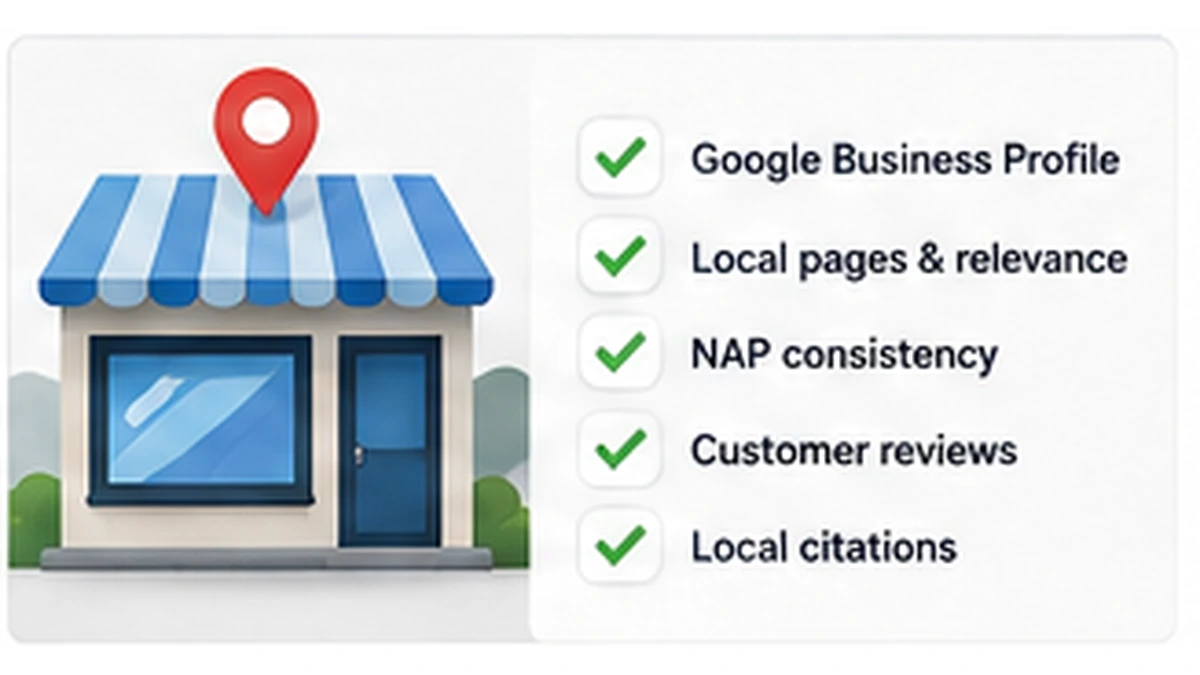
Local AI visibility is built on accurate business information and an established local search presence. Google names Google Business Profile specifically as an input to how a local business appears in AI responses as well as ordinary results.
Google Business Profile records the business name, category, address, service area, telephone number, opening hours, services and reviews. Incorrect or incomplete information affects how Google identifies and presents the business, in both formats.
Local pages explain the relationship between a service and the area it is delivered in. Thin location pages provide little evidence. Substantive pages describe the market, service conditions, coverage and the problems customers in that area actually have.
Local citations are external records of your name, address and telephone number. Conflicting records can make one business look like several entities, or attach outdated information to the current company.
Reviews supply first-hand evidence in customers’ own language about reliability, communication and outcomes. That is corroboration a business cannot write about itself.
This is local SEO, and it is the same work that produces AI visibility. That is the practical meaning of Google’s position.
Does Every Local Business Need AI SEO?
No. The correct priority depends on where your visibility problem starts, and for most businesses it does not start with AI.
A site with indexation or technical faults needs those fixed first. An AI system cannot reliably retrieve information from a page search engines cannot process.
A business with an incomplete Google Business Profile needs its local information corrected before any AI monitoring is worth paying for. Accurate details support conventional results and generated answers alike.
A company with generic service pages needs stronger business evidence, not more markup. Technical signals describe information. They cannot create expertise a page does not contain.
A business with established search performance may justify a wider AI visibility review, particularly where customers use AI tools to compare providers. That review identifies whether you appear, whether the description is accurate, and which competitors recur.
We establish the priority during the initial assessment. The free SEO Readiness Assessment gives an early indication if you are not ready to request a full audit.

What Dr IT SEO Handles
Dr IT SEO Services is a founder-led agency. You work directly with Vlad Tabaranu rather than being transferred to a junior account manager after the sale.
- Technical assessment. Whether search systems can access, process and index the relevant pages, and the repairs within the agreed scope.
- Local search assessment. Whether Google Business Profile information, location signals, reviews and citations support the correct business entity.
- Content assessment. Whether service pages answer real customer questions with specific, supportable information, plus the research and drafting to fix them.
- Entity assessment. Whether the company, people, services, locations and credentials are described consistently across every surface.
- Structured data. Whether machine-readable information matches visible content, then writing, validating and maintaining it.
- AI visibility assessment. Whether representative systems name, cite, omit or misstate the business, recorded as dated findings.
- Performance reporting. Whether visibility produces calls, forms and enquiries, connected to measurable actions where tracking permits.
Our pricing and plans combine ongoing local SEO, website management, monitoring and reporting. The free audit determines the appropriate scope before anyone commits to a plan.

What Dr IT SEO Cannot Guarantee
We cannot guarantee Google rankings, indexation, AI citations, or a permanent position inside a generated answer. Those outcomes belong to the search engine or the AI platform.
AI responses change because a system retrieves different sources, interprets a question differently, or updates its processes. Location, wording, timing and user context all affect the answer.
Search performance takes time, because search systems must crawl, process and reassess changed information. No honest provider converts that external process into a fixed completion date.
What we do guarantee is a documented scope, direct founder delivery, and an evidence-based account of the work. Our company background explains Vlad Tabaranu’s experience and how the founder-led model operates.

Final Answer: Do You Need AI SEO?
AI SEO is worth assessing when AI-generated search affects how customers find, compare or understand your business. That assessment still begins with technical SEO, local SEO, useful content, accurate business data and verifiable authority.
AI SEO is not a separate collection of Google hacks. Google does not require llms.txt, special AI schema, artificial content chunking, or a page for every possible prompt. It says so in writing.
AI visibility work is justified when an established business needs its website, local presence and external evidence assessed across both conventional and generated search. The value comes from correcting identifiable problems, not from attaching a new label to routine work.

AI SEO Questions
Is AI SEO a different service from SEO?
No. Google’s June 2026 position is that good SEO is good GEO, because its generative features use the same core ranking systems and the same search index. AI visibility is an outcome of foundational SEO rather than a separate discipline with its own requirements.
Do I need an llms.txt file?
Not for Google Search. Google states plainly that these files “are not needed” for its Search. Some non-Google systems read them, so we publish one where that is useful, and we never describe it as a Google ranking factor.
Can you guarantee my business appears in AI Overviews?
No, and neither can anyone else. Google decides whether to crawl, index, rank or cite a page even when that page meets every technical requirement. We correct what can be corrected and record what actually appears, with dates.
Should I rewrite my pages into short AI-friendly chunks?
No. Google states its systems understand language as a human does and that artificial chunking is unnecessary. Write clearly for readers, with real headings and coherent sections, and that structure serves both audiences.
What actually helps a local business appear in AI answers?
An accessible, indexed website; an accurate and complete Google Business Profile; substantive local pages; consistent citations; genuine reviews; and content only your business could write. Google names Business Profile as a direct input. Everything on that list is ordinary local SEO.
Request an SEO and AI Visibility Audit
The free audit is the next step when the source of a visibility problem is unclear. Vlad reviews your website, Google Business Profile and current search presence, then tells you whether the priority is technical SEO, local SEO, content, website work or wider AI visibility.
Send your website address, primary service and target area, or contact Dr IT SEO Services directly.
Mon-Fri 09:30-17:30. Dr IT SEO Services, 415 Court Oak Road, Harborne, Birmingham B32 2DX.
